

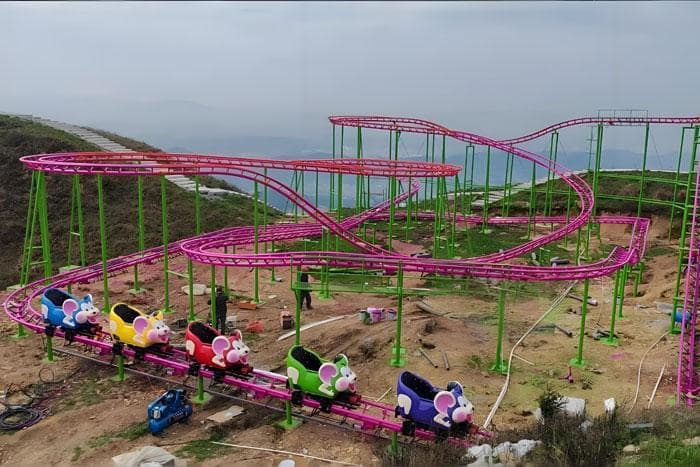
how much does a Prodigy backyard roller coaster cost in 2026? There is no single fixed price because Prodigy roller coaster pricing depends on the model, track length, passenger capacity, power system, theme, customization, transportation, installation, and destination. Current Prodigy-related pricing information places small and mini roller coaster configurations broadly from around US$15,000 to US$60,000, while larger commercial family coaster projects can cost substantially more.
For a precise quotation, buyers should request a project-specific price directly from Prodigy because online figures are estimates rather than binding offers.
2026 Prodigy Backyard Roller Coaster Price Guide
The following ranges provide a practical starting point for budgeting:
| Roller Coaster Type | Estimated 2026 Price | Typical Application |
|---|---|---|
| Non-powered mini coaster | US$5,000–15,000 | Private or small playground |
| Mini kids coaster | US$15,000–25,000 | Children’s parks, FECs |
| Small powered family coaster | US$20,000–60,000 | Resorts, malls, family parks |
| Mid-size family coaster | US$60,000–150,000 | Commercial amusement parks |
| Custom high-spec coaster | US$200,000+ | Large themed projects |
These are indicative market ranges, not fixed Prodigy quotations. Prodigy’s published materials also show configurations ranging from compact unpowered coasters to electric-powered family models and larger custom attractions.
What Is a Prodigy Backyard Roller Coaster?
Unlike a major theme-park roller coaster requiring hundreds of meters of track and extensive infrastructure, a backyard or mini roller coaster focuses on a compact footprint, moderate speeds, family-friendly operation, and customizable theming.
Prodigy’s smaller coaster offerings can be suitable for:
- Private entertainment properties
- Resorts
- Children’s amusement parks
- Family entertainment centers
- Shopping malls
- Tourist attractions
- Small outdoor amusement parks
For example, Prodigy’s Interstellar Mini Coaster is listed with a 116-meter track, 22-passenger capacity, 15 kW electric drive, and approximately 26 × 17.2 m footprint.
This demonstrates why mini coasters are attractive to investors with limited land.
7 Factors That Determine the Final Cost
1. Track Length and Layout
Track length is one of the most important cost factors. A simple compact circuit costs less than a longer layout featuring multiple curves, drops, elevated sections, or special effects.
More track generally means additional:
- Steel
- Engineering
- Supports
- Track components
- Installation work
Prodigy-related 2026 pricing information places compact 80–150 m family coasters at a substantially lower investment level than extended custom layouts.
2. Powered or Non-Powered System
A gravity-driven or non-powered coaster generally has a simpler mechanical configuration and lower initial cost.
An electric coaster requires motors, control systems, electrical infrastructure, and additional commissioning, increasing the investment.
3. Passenger Capacity
A two-person or small children’s coaster naturally requires less equipment than a 20–30 passenger commercial attraction.
Higher capacity can, however, increase potential revenue for commercial venues.
4. Theming and Customization
Themed fiberglass trains, dinosaur designs, cartoon characters, space themes, LED lighting, sound effects, and customized colors can increase the final price.
For a backyard attraction, customization can turn a simple coaster into a distinctive visual centerpiece.
5. Installation
The equipment purchase price is only part of the project budget. Installation may involve:
- Mechanical assembly
- Electrical connections
- Testing
- Commissioning
- Professional technicians
Prodigy provides factory-direct consultation and can support projects from park layout and installation through after-sales maintenance.
6. Shipping and Import Costs
International buyers must also consider:
- Ocean or land freight
- Insurance
- Customs duties
- Import taxes
- Port charges
- Local transportation
These costs vary considerably by destination.
7. Foundation and Site Preparation
Commercial roller coasters generally require appropriate foundations and structural preparation. Buyers should obtain the manufacturer’s foundation drawings and have local professionals verify soil conditions, construction requirements, drainage, electrical supply, and applicable regulations.
Key Selling Points of Prodigy Backyard Roller Coasters
Compact Design
Mini roller coasters can provide a coaster experience without requiring the enormous footprint of a major theme-park attraction.
Family-Friendly Experience
Many smaller Prodigy coaster concepts focus on children and families, expanding the potential audience beyond extreme thrill seekers.
Customizable Appearance
Operators can customize colors, graphics, fiberglass decoration, logos, and themes according to the project’s identity.
Commercial Flexibility
The same basic concept can potentially be adapted for resorts, FECs, tourist destinations, shopping centers, and small amusement parks.
Lower Entry Investment
Compared with large-scale steel coasters, compact Prodigy models can offer a substantially lower initial investment, making them attractive to first-time amusement investors.
Is a Prodigy Backyard Roller Coaster a Good Investment?
The answer depends on whether the equipment is intended for private enjoyment or commercial operation.
For a private backyard, ROI may not be the primary consideration. The value comes from entertainment, exclusivity, and creating a unique family or guest experience.
For commercial operators, however, the calculation should include:
Potential Revenue = Ticket Price × Riders per Hour × Operating Hours × Attendance
Then subtract:
- Labor
- Electricity
- Maintenance
- Insurance
- Marketing
- Site costs
- Taxes
- Financing
- Other operating expenses
A smaller coaster may have an attractive business case because its purchase cost and space requirements can be lower. However, no manufacturer can guarantee a specific payback period, since actual ROI depends on local visitor demand and operating conditions.
Backyard vs. Commercial Mini Roller Coaster
It is important to distinguish between a private backyard coaster and a commercial amusement ride.
A private installation may have different requirements from a ride operated for paying guests. Commercial operators should verify:
- Local amusement ride regulations
- Required certifications
- Engineering approval
- Passenger restrictions
- Insurance requirements
- Inspection procedures
- Operator training
- Emergency procedures
The cheapest equipment is not necessarily the best choice. For commercial applications, safety documentation, professional installation, spare parts, and after-sales support should be considered part of the investment.
2026 Amusement Industry Trends
1. Compact Attractions Are Increasingly Valuable
Land and construction costs can make large amusement projects difficult for smaller investors. Compact family attractions provide an alternative for resorts, FECs, malls, and tourism destinations.
2. Immersive Theming Is Becoming More Important
Visitors increasingly expect rides to provide a complete experience rather than simple mechanical movement. Dinosaur, space, fantasy, ocean, and cartoon themes can help create memorable attractions.
3. Family Entertainment Continues to Expand
FECs increasingly combine rides with arcade games, soft play, VR, food, parties, and other activities. A compact roller coaster can act as an anchor attraction within this diversified business model.
4. Customization Is a Competitive Advantage
In 2026, operators are looking for attractions that can differentiate their venues. Customized colors, themes, lighting, sound, and branding can make a small coaster more marketable.
5. Safety and Operational Efficiency Remain Priorities
Modern amusement projects increasingly emphasize preventive maintenance, intelligent controls, energy efficiency, professional inspection, and trained operators.
How to Get an Accurate Prodigy Roller Coaster Price
Because Prodigy roller coaster prices vary according to specifications, buyers should prepare the following information when requesting a quotation:
- Available site dimensions
- Indoor or outdoor installation
- Target passenger capacity
- Preferred track length
- Theme or design requirements
- Destination country
- Expected operating conditions
- Required certifications
- Installation requirements
- Shipping destination
Prodigy’s official contact page offers a factory-direct quotation service and states that buyers can request its 2026 amusement ride catalog and detailed price list.