

Table of Contents
- What Are Commercial Bumper Cars?
- Why Invest in Commercial Bumper Cars?
- Types of Commercial Bumper Cars
- Manufacturing Process and Quality Control
- OEM and ODM Customization Services
- How to Choose a Reliable Manufacturer
- Why Choose Prodigy?
- Frequently Asked Questions
- Conclusion
1. What Are Commercial Bumper Cars?
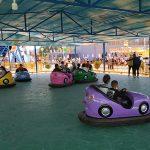
Commercial bumper cars are electric amusement rides designed for public entertainment venues, including amusement parks, theme parks, family entertainment centers (FECs), shopping malls, resorts, and indoor playgrounds.

Also called dodgem cars, these attractions allow riders to steer individual vehicles around a designated arena and enjoy interactive driving experiences. Commercial models are designed for repeated operation and require suitable structural construction, electrical systems, protective components, and maintenance arrangements.
A professional commercial bumper cars manufacturer should provide more than attractive vehicle designs. Buyers should also evaluate technical specifications, power configurations, customization options, safety documentation, and after-sales support.
2. Why Invest in Commercial Bumper Cars?
Bumper cars are popular family attractions because they combine simple controls, interactive entertainment, and friendly competition. They can appeal to children, teenagers, and adults, depending on the vehicle model and operating restrictions.
For amusement park operators, bumper cars can complement larger attractions such as roller coasters, Ferris wheels, and carousels. For FEC owners, they can provide an interactive activity alongside arcade games, bowling, and indoor playground facilities.
Key business advantages include:
- Broad audience appeal: Suitable models can serve different age groups and family visitors.
- Repeat-play potential: Guests may return for additional driving sessions.
- Flexible venue applications: Available configurations can accommodate selected indoor and outdoor projects.
- Custom appearance: Racing designs, colorful bodies, and themed graphics create distinctive attractions.
- Scalable equipment selection: Operators can select vehicle quantities according to venue size and expected demand.
Actual profitability depends on investment costs, visitor traffic, ticket prices, operating expenses, and local market conditions.
3. Types of Commercial Bumper Cars
Choosing the right power system is an important part of purchasing commercial bumper cars.
Battery Powered Bumper Cars
Battery-powered models use rechargeable batteries installed inside each vehicle. They generally do not require conductive flooring or an overhead electrical grid, providing flexibility for arena layouts and selected mobile applications.
Check battery capacity, charging time, operating duration, replacement costs, and charging facilities before purchasing.
Ground Grid Bumper Cars
Ground-grid bumper cars receive electricity through a specially designed conductive floor. This configuration is suitable for permanent arenas with compatible flooring and electrical infrastructure.
It can support continuous operation without relying on onboard battery charging, but professional installation is required.
Ceiling Grid Bumper Cars
Ceiling-grid bumper cars use an overhead electrical collection system and a compatible conductive floor. This traditional configuration is commonly considered for permanent indoor bumper car arenas.
Buyers should evaluate ceiling height, electrical requirements, floor construction, and maintenance access.
Racing and Themed Bumper Cars
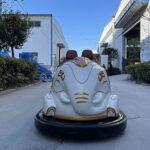
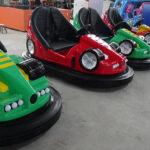
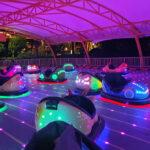
Racing-style vehicles, sports-car designs, animal-themed models, and futuristic bumper cars can help operators create unique entertainment experiences. LED lighting, music, and customized graphics may also be available depending on the model.
4. Manufacturing Process and Quality Control
A reliable commercial bumper cars manufacturer should follow a documented production and inspection process.
Typical manufacturing stages include:
- Engineering design: Confirm vehicle dimensions, structure, capacity, and electrical configuration.
- Material preparation: Select steel, fiberglass, rubber, motors, and electrical components.
- Frame fabrication: Manufacture and assemble the supporting chassis.
- Body production: Create, finish, and paint the vehicle body.
- Electrical assembly: Install motors, controllers, wiring, batteries, and lighting.
- Functional testing: Inspect steering, electrical systems, protective components, and operating functions.
- Final delivery: Prepare the vehicles, accessories, manuals, and spare parts for shipment.
Before ordering, ask the manufacturer about inspection procedures, material specifications, test records, and acceptance criteria.
5. OEM and ODM Customization Services
Customization allows amusement businesses to develop bumper cars that match their branding and venue themes.
Depending on the manufacturer’s capabilities, OEM and ODM services may include:
- Custom vehicle colors and exterior designs.
- Company logos and promotional graphics.
- Racing, cartoon-inspired, and futuristic themes.
- LED lighting and sound effects.
- Different seating configurations.
- Selected motor and power system options.
- Customized packaging and accessories.
Buyers should approve technical drawings or product renderings before production. Confirm customization costs, minimum order quantities, and delivery schedules in writing.
6. How to Choose a Reliable Manufacturer
Selecting the right manufacturer can influence equipment performance, maintenance costs, and long-term operating reliability.
Consider these purchasing factors:
Manufacturing experience: Review the company’s history, production facilities, engineering team, and completed amusement projects.
Product specifications: Request dimensions, passenger capacity, motor power, speed limits, materials, and electrical requirements.
Safety documentation: Ask for applicable certificates, inspection reports, operating instructions, and maintenance manuals for the exact model.
Quotation transparency: Compare equipment prices, accessories, spare parts, packaging, shipping, and installation costs.
After-sales service: Confirm warranty conditions, replacement component availability, technical support, and installation guidance.
Export capability: Discuss international shipping, export documentation, delivery terms, and local installation responsibilities.
A factory visit or independent pre-shipment inspection can provide additional confidence before placing a major order.
7. Why Choose Prodigy?
Prodigy, operated by Zhengzhou Prodigy Amusement Equipment Co., Ltd., is a Chinese amusement equipment manufacturer with experience in commercial ride production since 1999.
Its bumper car product range includes battery-powered bumper cars, ground-grid models, ceiling-grid systems, racing-style vehicles, and themed designs.
Prodigy provides customization and project support for different amusement business requirements, including:
- Multiple commercial bumper car configurations.
- OEM and ODM design discussions.
- Custom vehicle appearances and branding.
- Equipment selection for indoor and outdoor venues.
- Project planning and technical communication.
- Installation guidance and after-sales support.
Beyond bumper cars, Prodigy also supplies Ferris wheels, carousels, roller coasters, pendulum rides, and other amusement attractions.
Visit the Prodigy commercial bumper cars manufacturer page to explore available products and purchasing information.
For a more accurate quotation, provide your project location, arena dimensions, required vehicle quantity, preferred power system, customization requirements, and expected delivery date.
8. Frequently Asked Questions
What should I look for in a commercial bumper cars manufacturer?
Evaluate manufacturing experience, technical specifications, quality-control procedures, safety documentation, customization options, warranty conditions, and spare-parts support.
Are commercial bumper cars suitable for indoor and outdoor use?
Some models are designed for indoor and outdoor applications. Confirm the exact model’s environmental requirements, flooring conditions, and electrical configuration with the manufacturer.
Which power system is best for commercial bumper cars?
Battery-powered models offer layout flexibility, while ground-grid and ceiling-grid systems may suit permanent arenas. The best option depends on venue infrastructure and operating requirements.
Can manufacturers produce custom bumper cars?
Yes. Depending on the manufacturer, customization may include body styles, colors, logos, lighting, and selected technical configurations.
Does Prodigy supply bumper cars for amusement parks?
Prodigy offers several commercial bumper car configurations for amusement parks, FECs, and other entertainment venues. Contact the company to confirm current models, specifications, and project support.
9. Conclusion
Choosing a reliable commercial bumper cars manufacturer is essential for developing a successful amusement attraction. Buyers should compare product quality, power systems, customization capabilities, safety documentation, and after-sales services before making a decision.
Prodigy offers different commercial bumper car solutions for international amusement projects. Contact the manufacturer with your venue requirements to discuss suitable models, technical specifications, and a project quotation.